St. Louis City beat Columbus on penalties after a tense 0-0 final, with tactical adjustments and a charged crowd defining the 2026 Open Cup.
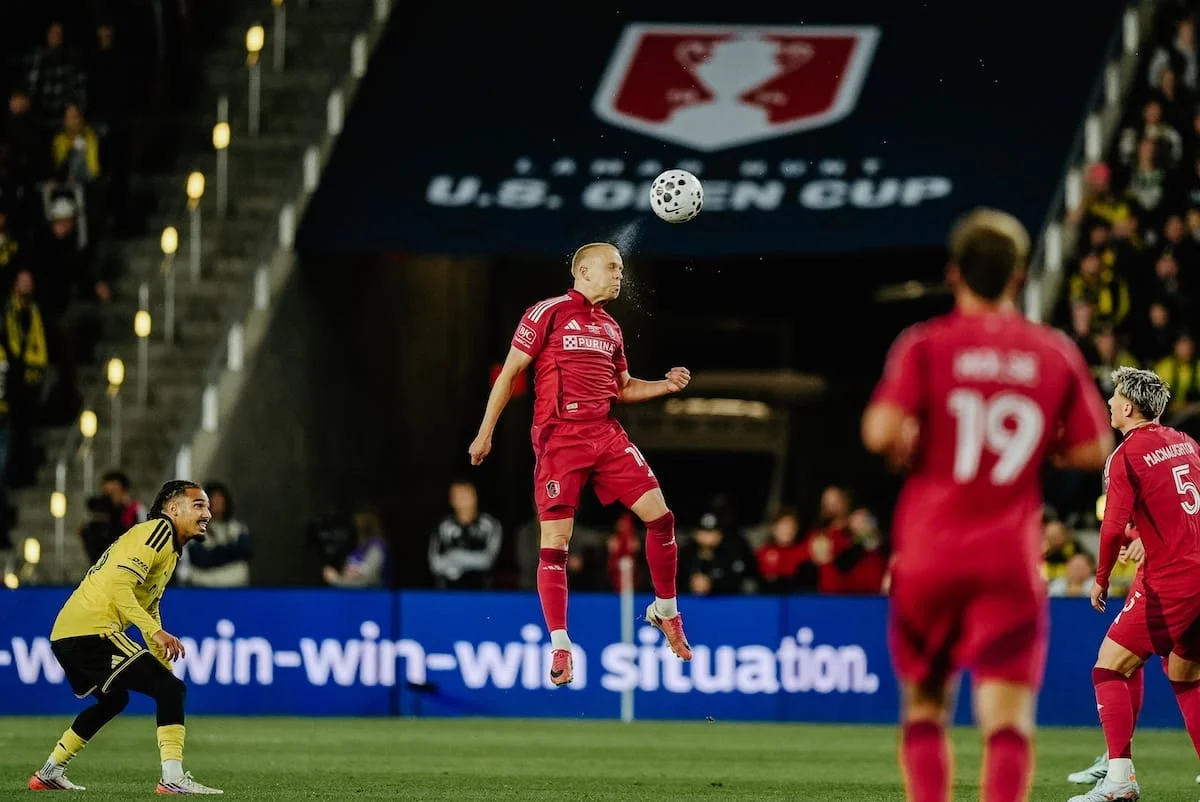
St. Louis City’s 2026 U.S. Open Cup title came down to penalties, but the final’s defining contest unfolded in midfield. After 90 minutes without a goal, St. Louis beat the Columbus Crew in a shootout at a sold-out Scotts Miracle-Gro Field, capping a tournament that began qualifying in fall 2025. The scoreline gives the simplest account of the finish, but it doesn’t explain how the teams spent the match trying to control one another’s routes through the center of the field. In a cup final, where one mistake can decide everything, keeping that contest unresolved was its own kind of pressure.
The match brought intensity more than elegance. Both teams tried to play through pressure, but tight marking, forceful pressing and a quick whistle repeatedly disrupted their buildup. That combination made possession hard to turn into sustained attack: a team could advance, only to find its next pass crowded out or the rhythm interrupted. The result felt like a final well before the shootout settled it. The tension came less from a stream of chances than from the sense that neither side could take control for long.
A tactical fight in midfield
St. Louis manager Yoann Damet set his team up to press aggressively. His side ranks second in MLS for passes allowed per defensive action, a measure that reflects how quickly a team tries to pressure opponents in possession. That approach is intended to make build-up uncomfortable and force hurried decisions, but Columbus found more success playing through it than St. Louis would have wanted. St. Louis midfielders Chris Durkin and Daniel Edelman tracked the Crew’s central pair in a 5-2-3 shape, yet Columbus rarely had trouble building through the lines. The detail matters: a pressing plan can look active without actually steering the opponent toward the areas where it’s easiest to win the ball.
The Crew’s own 5-2-3 used a deeper line of confrontation. That restraint helped Columbus stay compact while still pressing, encouraging St. Louis to attempt riskier passes and giving the home side less control over where the game was played. A deeper starting position can leave an opponent more room to begin an attack, but it can also limit the space available once that attack reaches midfield. Columbus was asking St. Louis to take the initiative and then trying to make the next pass difficult. It was a pragmatic choice, and it made the match’s central area feel crowded without requiring the Crew to chase every early pass.
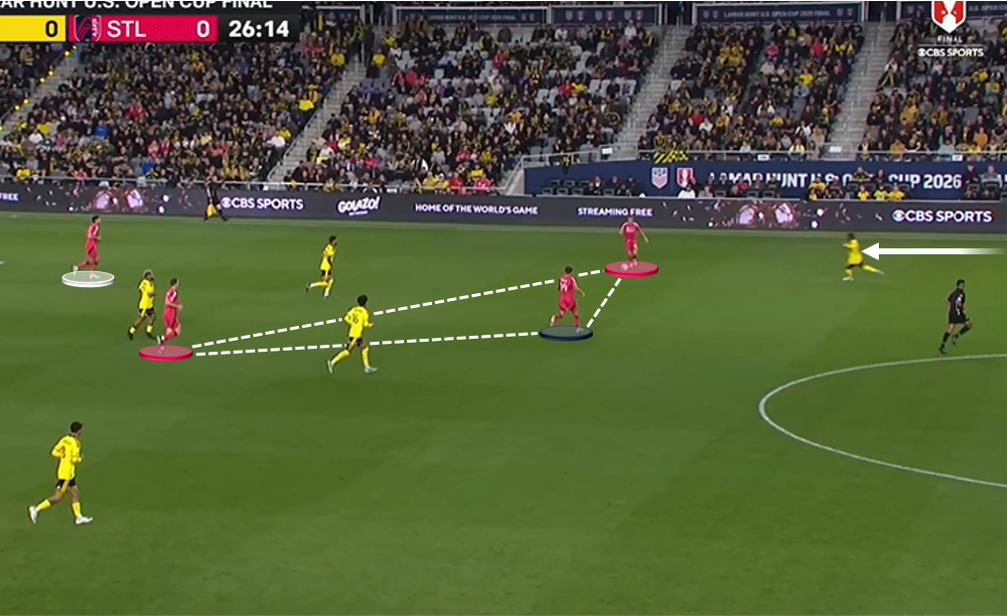
St. Louis often went long from the back to bypass the Crew’s press. That option can relieve pressure, but it also hands the next phase of play to the contest for the second ball; a long pass only changes the problem if teammates are positioned to compete for what follows. Its more effective sequences came when the team used its full possession shape to stretch Columbus’ front line and keep the Crew’s midfield pivot from offering cover. In other words, the long ball was one tool, not the whole answer. St. Louis had more scope to progress when its players moved in relation to one another and made Columbus defend a wider set of possibilities.
Damet described that flexibility in an interview with Backheeled: “We have different structures that I like for different reasons, whether because it gives us a numerical advantage or it gives us a positional advantage and makes things difficult in terms of defensive references for the opposition.” The point is less about choosing a single formation than about using player positions to create problems for defenders. Numerical advantages can give a team an extra passing option in an area; positional advantages can put a player where an opponent’s marking scheme doesn’t have an obvious answer. Those ideas are easy to describe in the abstract, but they only matter if the movement gives the ball carrier a useful next pass.
The shape was visible in one buildup: Edelman received near the left touchline, while the nearest Columbus winger stayed occupied by center back Dante Polvara. Durkin held a central position to preserve an outlet through midfield. Right-sided player Conrad Wallem had pushed forward and drawn a marker; attacker Carlo Holse dropped in instead, completing a passing triangle that helped St. Louis move through the lines. Each position affected the next: Wallem’s movement drew attention, Holse filled the space that opened, and Durkin remained available as a central option. It’s a small sequence, but it shows why a team’s shape is better understood as a set of relationships than as a static diagram.
A final that matched the occasion
More than 20,000 fans filled the stadium. Columbus’ Nordecke brought a wall of yellow, met by a traveling contingent of St. Louis supporters in red. The opposing colors gave the match a clear visual frame, but the atmosphere also reflected what was at stake for the two sets of supporters: a cup final in which every stoppage and every attacking spell could feel consequential. CBS used cameras on drones, referees and fans to bring viewers close to the action, while the play itself stayed tense and combative. The broadcast could widen the view of the occasion, but it couldn’t make the football any less cagey.
St. Louis’ victory rested on surviving that pressure and finding moments to build with purpose. The final offered no goals in regulation, but the tactical duel, the crowd and the shootout gave the 111th Open Cup a fitting finish. That said, a penalty shootout can turn a whole evening into a story about its last few kicks, leaving the work that shaped the match in the background. Here, the midfield contest deserves a place in the account: it was where each team tried to narrow the other’s choices, and where St. Louis found ways to create passing routes when its structure clicked. The numbers here are underwhelming if you’re looking only for goals. The game itself had other stakes.
What the win says about cup football
This is more significant than it looks: St. Louis lifted the trophy after a final in which its preferred pressure didn’t simply overwhelm the opponent. Columbus found routes through that press, and St. Louis had to adjust how it built from the back. The match therefore offers a more useful picture of the team than a tidy win would have: its tactical identity included both an aggressive press and the ability to vary its possession shape when that press wasn’t enough. That kind of flexibility doesn’t guarantee a result, but it can give a team more ways to stay in a match when its first plan meets resistance.
If you’re working in this space, the takeaway is that formation labels only explain part of a final like this. The same 5-2-3 can press high, sit deeper or shift its coverage depending on how the players position themselves and which passing lanes they choose to close. (And this is the part most people overlook.) A team’s shape is also a way of deciding what risks it’s willing to accept: leaving a player available in midfield may help with progression, while pushing someone forward may draw a defender away from a more useful space. The match didn’t resolve those trade-offs with a goal. It carried them all the way to penalties.
Qualifying began in fall 2025, and the final closed the tournament months later with a result that hinged on the shootout. Between those points, this match showed how a cup run can culminate in a contest shaped by patience as much as attack. The trophy went to St. Louis, but the final’s lasting interest lies in how the teams tried to control the route to the goal. No easy answer. Just a narrow margin, a loud stadium and a midfield fight that remained unsettled until the final kicks.
Discussion
Sign in to join the discussion.